
2025 · Turnkey Training Infrastructure · Mumbai
Mumbai Metro Training Institute, MMMOCL
Thirty-three rooms across three buildings, delivered four days ahead of the contractual deadline for the training institute of India’s newest metro operator. The brief included two hybrid auditoriums, fourteen smart classrooms, and a decentralised architecture designed for parallel commissioning across the campus. Mid-contract, at the client’s request, the programme extended to five operational metro locations across the network.
The Challenge
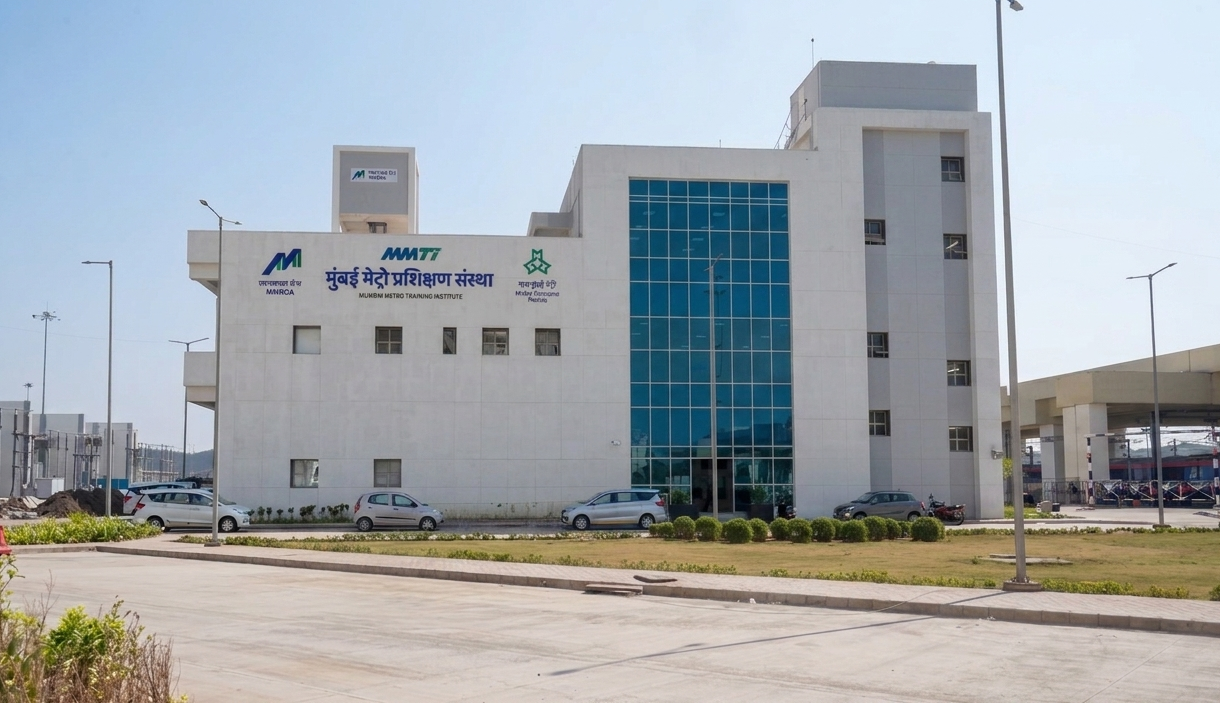
The Maha Mumbai Metro Operation Corporation Limited (MMMOCL) operates Mumbai Metro Lines 2A and 7, and through its Mumbai Metro Training Institute (MMTI) trains the operating and maintenance personnel who run them. The institute’s ambition extends beyond internal readiness. MMTI is intended as a commercial training product — a facility that can host personnel from metro operators across India. That ambition demanded a facility that was not merely functional but demonstrable: a place that visiting counterparties could walk through and take seriously.
The scope was thirty-three rooms across three buildings on a training campus at some distance from MMMOCL’s headquarters at Bandra-Kurla Complex. Fourteen smart classrooms, five hybrid classrooms, two hybrid conference rooms, two hybrid auditoriums, a computer lab, and nine interior-works spaces. The three buildings — the DCC Building, the Simulator Building, and Metro Bhawan — were at different stages of civil readiness, and the civil contractor was scheduled to work in parallel with AV execution, not ahead of it.
The contractual window was one hundred and twenty days from the Letter of Award dated 18 August 2025. The Maharashtra Government’s inauguration of the relevant metro line set a fixed operational-readiness milestone inside that window. Site access was through a high-security compound, material and sample approvals travelled the distance to Bandra-Kurla Complex and back, and acceptance testing ran through a multi-stakeholder review where some reviewers were not party to the original scope.
The Solution
The architectural decision at outset was decentralisation. Each of the thirty-three rooms was designed to operate independently, so that commissioning could proceed in parallel across the three buildings as the civil contractor released each shell. MMTI’s training manager directed the priority order in real time, and rooms were handed over against his sequencing rather than a predetermined schedule.
The tender drew the specification from specific OEMs across every system layer, without downward substitution permitted. Audio was built on Sennheiser, Shure, Audac, Yamaha, and QSC. Video on Samsung, ViewSonic, Canon, Arec, and Osel. Control and switching on Aten, Kramer, and Key Digital.
The auditoriums
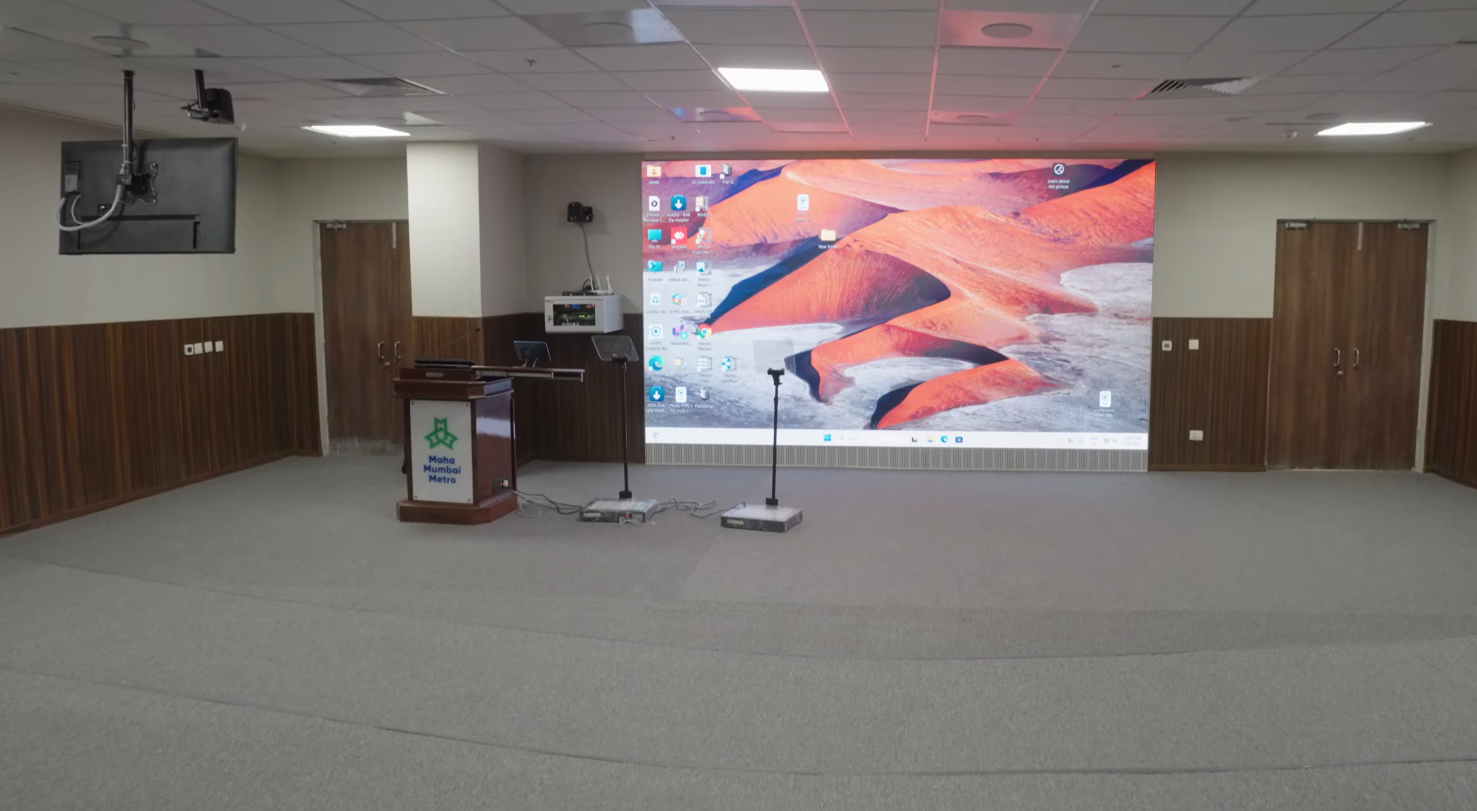
The two hybrid auditoriums sit in the DCC Building and in Metro Bhawan. The audio chain in these spaces was built on a matched Sennheiser and QSC pairing. The two product lines integrate natively at the DSP layer, which meant that the path from beamforming capture through signal processing to amplification operated as a single engineered system, not a chain of independently specified components.
The acoustic environment of the auditoriums received particular attention. In one of the two, the uninterruptible power supply was relocated approximately fifty metres into a separate building facility and fed back over the power infrastructure, to remove the UPS’s acoustic and thermal signature from the listening space. Acoustic and topology design was led under AVIXA CTS-D certification by the General Manager — one of a small number of such design reviews in India undertaken inside the integrator rather than inside an OEM.
The conference rooms
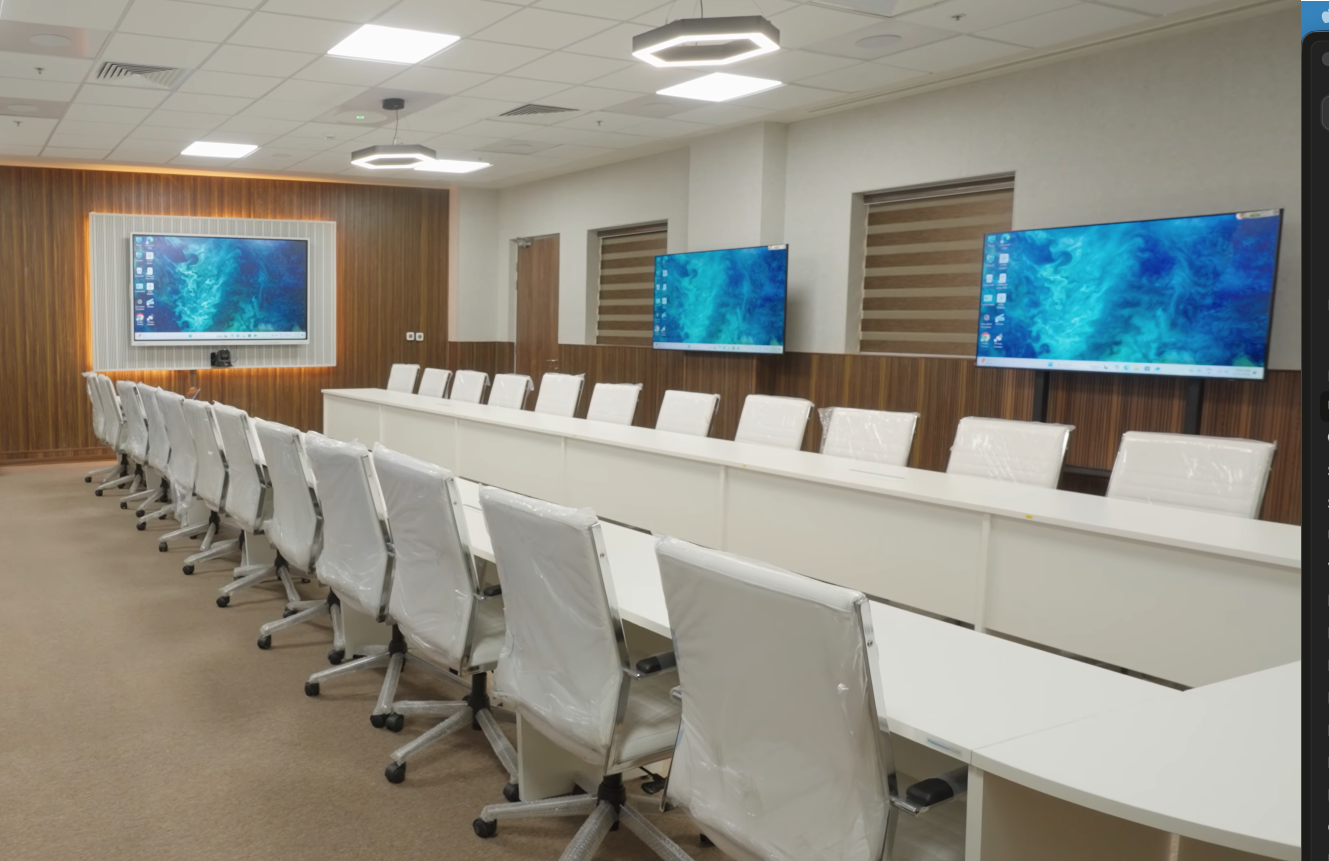
The case for independent certified design surfaced most sharply late in the commissioning of the hybrid conference rooms. Ceiling-mounted air-conditioning units had been fixed by the HVAC contractor without reference to where the ceiling-beamforming arrays were to sit. Physical rework would have cost weeks of schedule, and was avoided. The beamforming arrays were instructed at the firmware layer to exclude the HVAC-affected zones, and residual ambient was handled in the DSP through gating, parametric equalisation, and noise-reduction programming. Speech-intelligibility targets held. A topology specified to be resilient had absorbed a site reality it was not originally drawn for.
Decisions outside the bill of quantities
A number of the decisions on this project sit outside the bill of quantities. The hybrid conference rooms had no wall space for display mounting; floor mounts were supplied. Window treatment was extended with additional blinds beyond the tender’s schedule. The furniture specification was lifted to Nilkamal across the programme, so that the rooms presented as the institution’s ambition required. Equipment racks were built on site after material inspection rather than pre-built at Dwarka — compliance taking precedence over speed.
The Outcome
The core thirty-three-room scope was handed over on or about 12 December 2025 — four days ahead of the 16 December contractual deadline. The facility was operationally live from mid-December, in time for the Maharashtra Chief Minister’s inauguration of the metro line. MMTI has since run its training programme through the spaces, and review visits from MMMOCL’s Managing Director, from the Mumbai Metropolitan Region Development Authority, and from the New Development Bank have been routine.
During execution, MMMOCL asked the team to undertake additional deployments at five operational metro locations across the network — Charkop, Dahisar, Anand Nagar, Kurar, and Wadala — extending the programme beyond the original training-campus footprint. The additional work included an outdoor LED display commissioned at Dahisar station. This extended phase was completed in March 2026.
What this proves
This case demonstrates, narrowly, that a topology specified with resilience in mind — a decentralised architecture, a natively-integrated audio path, acoustically isolated power — absorbs site realities that a less-considered specification would not. It also demonstrates institutional trust in a concrete form: a state-owned metro operator extending its brief mid-contract to bring a contractor onto its operational network is not a certificate, but it is evidence. Further reading: the Design Advantage page, the Auditoriums solution, and the Infrastructure sector evidence.