
2025 · Campus Fit-out · Vadodara, Gujarat
The Maharaja Sayajirao University of Baroda
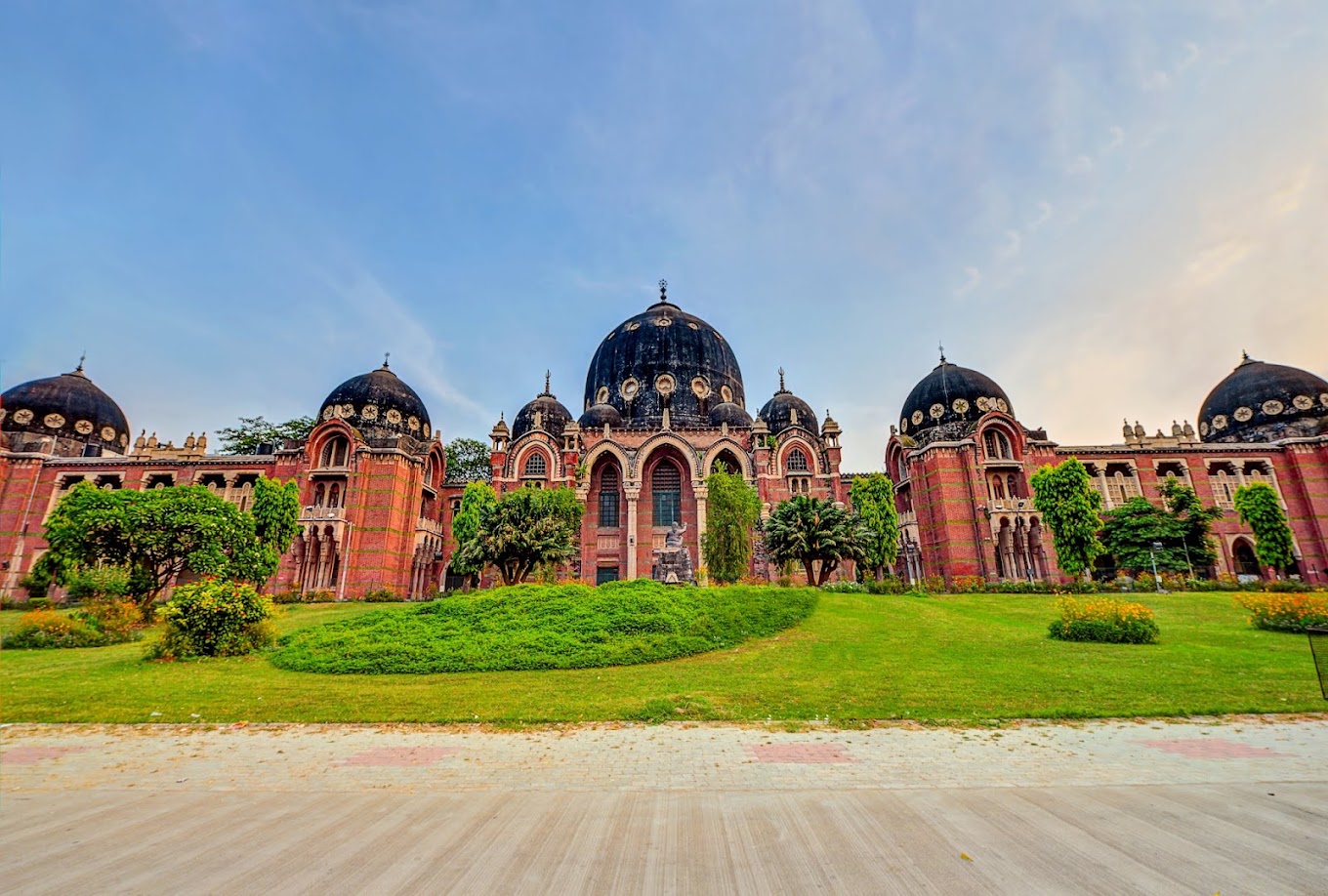
A newly-handed-over building on The Maharaja Sayajirao University of Baroda’s campus required its first-fit audio-visual infrastructure — seven rooms of three distinct kinds, commissioned in parallel across two GeM contracts placed three weeks apart, for operational readiness by the July 2025 academic session.
The Challenge
At The Maharaja Sayajirao University of Baroda’s campus in Vadodara, a newly-handed-over building required its first-fit audio-visual infrastructure ahead of the July 2025 academic session. Seven rooms inside the building needed commissioning — a 23-seat hybrid committee room, a seminar hall, and five teaching classrooms — and each required a fundamentally different audio-acoustic regime from the others.
The university had scoped the tender with unusual technical rigour. Independent AV design input had been sought during the pre-tender phase, and the specification that issued correctly distinguished between the three acoustic regimes rather than applying a one-size-fits-all brief across the seven rooms. This clarity at tender stage meant fewer post-award surprises and a cleaner handover — but it also committed the successful bidder to delivering three engineering disciplines in the same building, to the same calendar, against the same session opening.
Alongside the AV scope rode the civil and fit-out package: acoustic wooden wall panelling, floor carpeting, bespoke conference furniture, custom display mounts, projection-screen housings, and power-backup infrastructure serving the building as a whole.
The Solution
Two GeM contracts were awarded to EAPL three weeks apart — the first covering the committee room and seminar hall with their civil and acoustic scope, the second covering the five classrooms. Both were executed as a single parallel campaign: the three-topology audio architecture, the seven rooms’ displays, the civil-and-fit-out package, and the building-level power infrastructure were coordinated through EAPL’s project office as one turnkey scope rather than as separate sub-contracts running alongside each other.
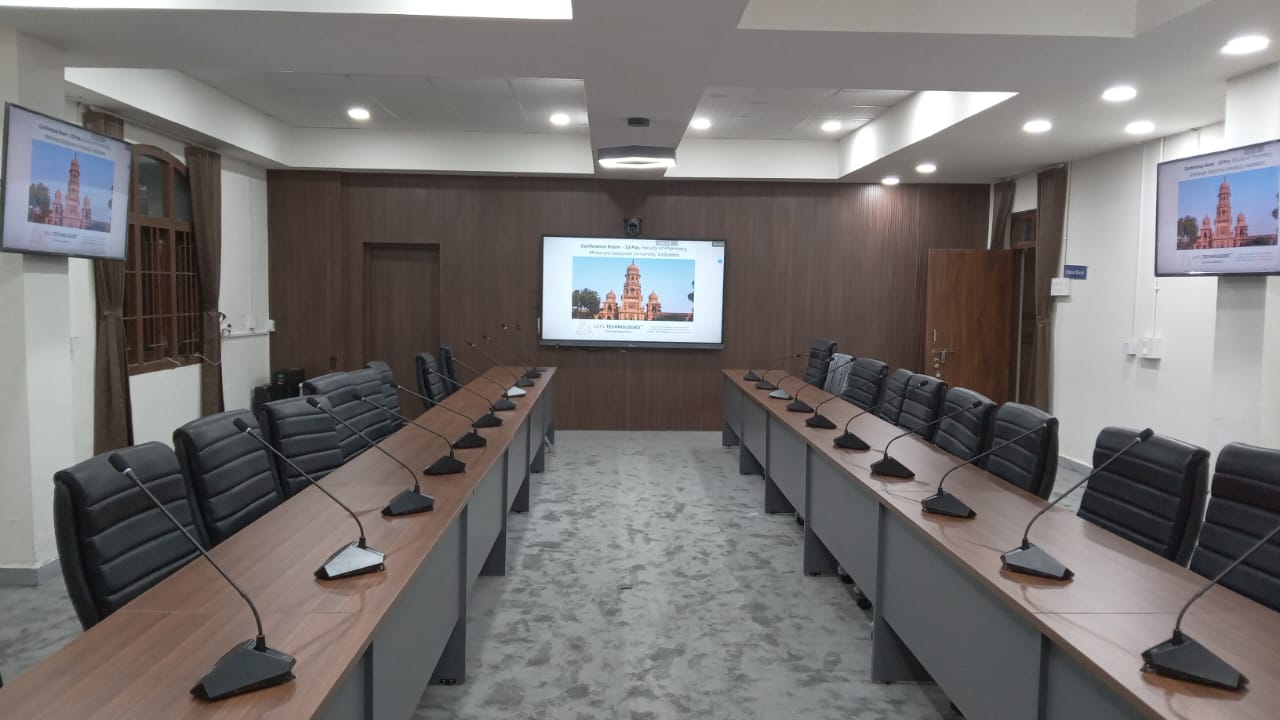
The 23-seat hybrid committee room
The committee room was built around a formal chairman-and-delegate discussion architecture: a chairman unit plus 22 gooseneck delegate units, wired into a multi-channel digital signal processor with native VoIP-USB for hybrid conferencing, amplified onto passive wall speakers. An 86-inch interactive panel served as the main shared display, flanked by two 50-inch confidence monitors for remote-participant presence.
The civil package underneath carried equal engineering weight — acoustic wooden wall panelling specified for the room’s reflective geometry, floor carpeting, a bespoke U-shaped conference table and seating, and a customised mounting structure for the interactive panel.
The seminar hall
The seminar hall audio was built for presenter-driven use: wireless handheld and lapel microphones feeding the same DSP-and-amplification chain onto distributed speakers for a seated audience. A laser projector paired with a 150-inch motorised screen served the primary visual; a PTZ camera with twelve-times optical zoom captured the lectern position for session recording and distribution.
At the stage, EAPL’s processor-based digital lectern carried the full integration — workstation compute, a 21.5-inch interactive touch monitor, multimedia controller, gooseneck microphone, an HDMI matrix for source switching, and a dual-HDMI USB-C capture for laptop annexation.
The five classrooms
Each of the five teaching classrooms ran the simplest of the three audio regimes — a single wireless lapel microphone per room, amplified onto two wall speakers — a faculty-mobility acoustic for a teacher addressing a seated cohort. A 75-inch interactive panel served as the front-of-room display. Each classroom carried its own line-interactive UPS for device-level power protection.
Building-level infrastructure
Behind the seven rooms ran shared infrastructure: a 3.0 KVA online UPS with a battery rack powering the committee room’s integrated stack, line-interactive UPS instances at every other commissioned position, and the power-and-signal conduit for the building installed once up front rather than seven times.
The Outcome
The seven rooms were commissioned to client expectation. The newly-handed-over building went from shell-interior state to operational teaching and committee facility in a single parallel campaign, ready for the July 2025 academic session.
The engineering that the university had committed to at tender stage — three distinct audio regimes, full civil and acoustic treatment, building-level power infrastructure, and seven rooms brought up together rather than in sequence — held through execution. The technical rigour of the pre-tender scoping produced a specification that did not require mid-course correction; the delivery windows on both contracts closed to client satisfaction.
What this proves
This case demonstrates, narrowly, that a newly-handed-over university building can be fitted out end-to-end in one parallel campaign — three distinct audio-acoustic topologies, seven rooms, a full civil and fit-out scope, and building-level power infrastructure, delivered as a single turnkey contract rather than multiple sequential trades. Further reading: the Conference & Boardrooms solution, the Classrooms solution, and the Higher Education sector evidence. A technically-scoped tender, met in turnkey form, is the cleaner delivery path for the institution.