
2023–2025 · AV Infrastructure · Dehradun
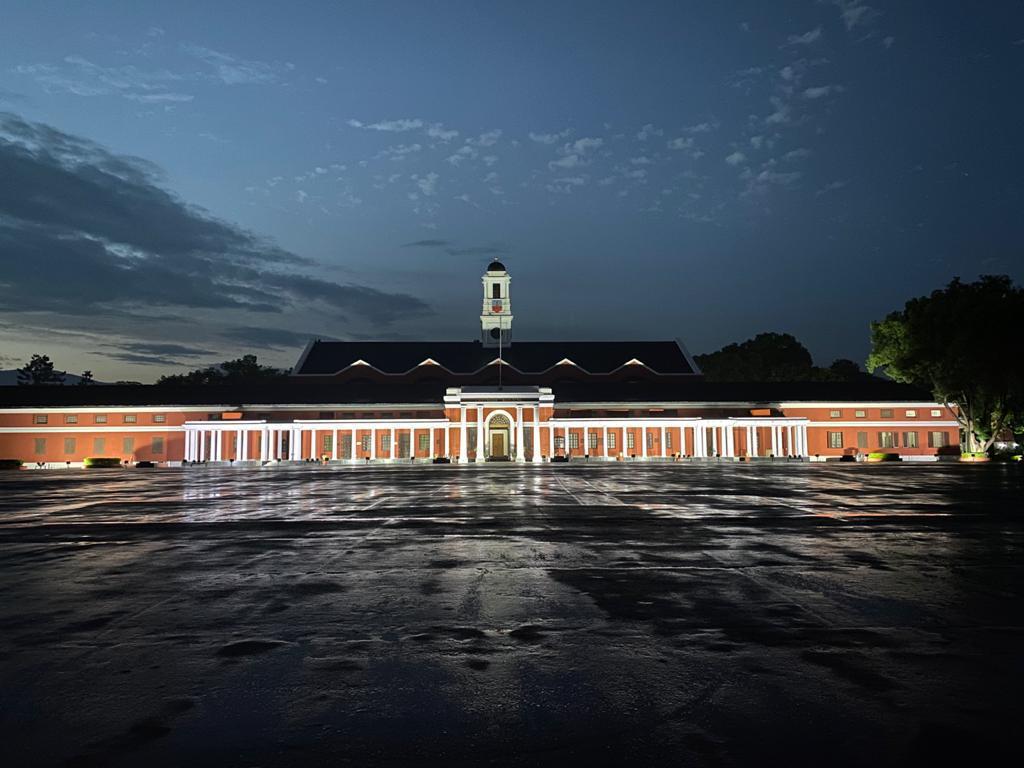
Indian Military Academy, Dehradun
Across four separate procurements between 2023 and 2025, the Indian Military Academy commissioned EAPL to build forty-two classroom teaching platforms and one acoustically demanding senior conference room. The work happened outside training hours, across heritage and modern buildings, in a campus that does not pause.
The Challenge
When work began at the Indian Military Academy in early 2023, the substrate was not a blank slate. Interactive flat panel displays had already been installed across the target rooms by a previous vendor, but mounted at heights that did not match the rooms’ seating lines, with absent cable management, unsafe power runs, viewing-angle geometries wrong for their rooms, and backing plates missing from several installations. Sound reinforcement was non-existent — the panels had been installed as displays only. What the institution required, in effect, was the full teaching platform: a processor-driven digital podium with integrated touch monitor, visualiser, pen-display surface, amplified loudspeaker coverage, wireless microphone system, and the signal routing that binds these together.
Thirty-seven classrooms were specified in the first contract; five more would follow in a repeat procurement two years later. The rooms sat across the campus — some inside the century-old Chetwode Building, others in later instructional blocks — each substrate carrying its own constraint profile. Work had to proceed outside training hours only; no room could be taken offline while cadets were in session.
Separately, the Academy’s principal conference room posed an acoustic problem of a different order: a domed ceiling rising more than nine metres above the floor, hard wooden surfaces on every side, and flutter echoes that placed the full conventional toolkit of ceiling-mounted microphone arrays physically out of reach.
The Solution
The classroom engagement began with work that sat outside the contracted scope. Before any teaching platform could be installed, the existing displays had to be made safe and usable. EAPL’s field teams remounted panels to correct seating-line heights, redid power runs to current wiring standards, fitted the backing plates that had not originally been installed, corrected viewing-angle geometries, and in several rooms levelled the wall surface to produce a uniform mounting substrate. The institution authorised the rectification during execution; EAPL absorbed the cost. The contracted teaching platform was then built on top of a known-good display layer.
Each classroom received a full EAPL digital podium as the teaching platform. The integrated system ran across three layers — video: an Acer interactive touch monitor, a teaching PC, and a Wacom pen-display writing surface, with a gooseneck visualiser; audio: a Biamp mixer-amplifier driving a four-unit Biamp wall-mount loudspeaker array, and a Shure dual-channel UHF wireless kit providing a lapel and a handheld microphone per room; control: a Cypress matrix switcher for signal routing, with a line-interactive UPS conditioning the whole stack. Each room stood as an independent island, but all forty-two rooms were configured identically — a discipline that matters in an institution with rotating instructors.
The wireless microphone density was the most demanding engineering call on the classroom side. Forty-two rooms, each running two UHF channels at concurrent peak, implied eighty-four simultaneous transmissions inside a single cantonment. The Shure system was selected specifically for its UHF frequency-agility and diversity-receiver performance. Frequencies were committed at commissioning as a fixed per-room map, with per-group scan-and-lock retained as a troubleshooting fallback. Where initial band allocations surfaced as too close during commissioning, transmission powers were reduced on the affected pairs, and in some rooms channels were reassigned outright.
The conference room required a different instrument entirely. A nine-plus-metre domed ceiling and hard reflective surfaces produced flutter echoes and placed the usable pickup zones of conventional ceiling-mount beamforming arrays well out of reach. The system was built on Nureva’s dual-unit wall-mount audio conferencing configuration, whose Microphone Mist architecture populates the room volume with thousands of virtual microphones rather than a handful of fixed lobes — a geometry that handles both the ceiling height and the flutter-echo environment. Acoustic design for the room was reviewed under AVIXA CTS-D certification — a review undertaken inside the integrator rather than at an OEM, which is the usual place such reviews happen in India. An LG 86-inch interactive display sat on the presentation wall, control ran through Crestron, and hybrid participation was supported by a Lumens PTZ camera.
The Outcome
Each of the four contracts handed over ahead of contractual deadline. The first classroom batch — thirty-seven rooms — was completed inside a sixty-day window that included the absorbed rectification and wall-levelling work, executed by parallel teams across multiple buildings, working only outside training hours. The conference room followed in early 2024 and was commissioned inside its window. A speech teleprompter pair was delivered in August 2025. Five additional classrooms were commissioned in December 2025, built to the same configuration as the 2023 batch — the repeat procurement was itself the acceptance test.
Every room commissioned is in rigorous daily use for the training of Gentlemen Cadets of the Indian Military Academy. Four separate GeM procurements, placed by the same institutional IT cell, across thirty-two months.
What this proves
What this case demonstrates, narrowly, is that a single institutional IT cell, once it finds engineering it can trust, will extend that trust across entirely different room types. Four GeM contracts, four different kinds of work, thirty-two months — the pattern itself is the evidence. Readers looking for the adjacent material might turn to the Classrooms and Training Rooms and Conference and Boardrooms solution pages, and the Defence sector evidence. The specific thing this case shows, though, is that absorbing inherited problems quietly — before the contracted work begins — is what lets institutional trust survive its first real test.