
2020–2022 · Hybrid Classroom · Burla, Odisha
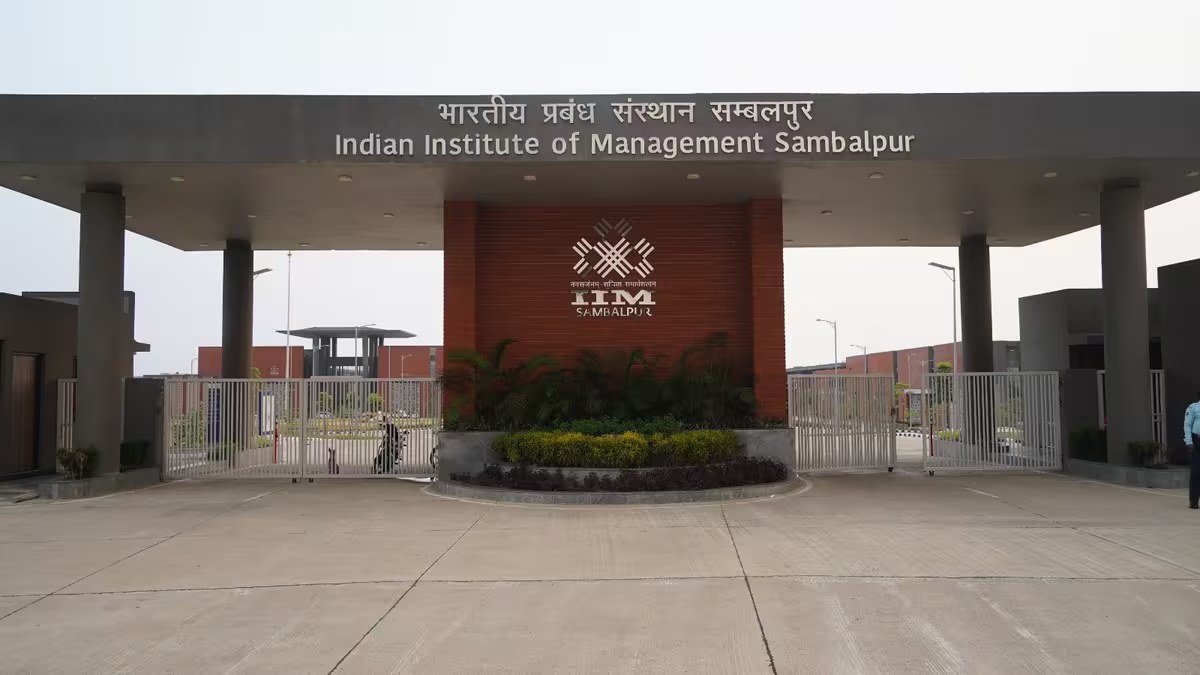
Indian Institute of Management, Sambalpur
A three-year hybrid-classroom programme at one of India’s newest IIMs, delivered in three tranches through the pandemic and its aftermath. The first tranche was commissioned at IIM Sambalpur’s Burla campus in October 2020 — during India’s Unlock-phase movement restrictions; the third, in November 2022.
The Challenge
The Indian Institute of Management, Sambalpur — one of the youngest IIMs, established in 2015 and operational from its permanent Burla campus only since 2019 — had its academic calendar interrupted by the pandemic shortly after moving in. By the second half of 2020, the institute was operating in two modes at once: a fraction of the cohort had returned to campus under distancing protocols, while the remainder continued to join sessions over video. The classrooms had to serve both populations — as hybrid teaching rooms for those physically present, and as broadcast studios for faculty delivering to those joining remotely.
The acoustic requirement carried the weight. Faculty speech had to reach remote participants cleanly over a compressed VoIP codec, without the echo and drop-outs a consumer-grade conferencing stack would produce; at the same time, in-room audio had to reinforce intelligibility for a distanced, masked student body seated further apart than normal. Either requirement alone is routine; both at once is not.
The first tranche carried a thirty-day contractual delivery window against a GeM procurement dated 1 October 2020 — placed, executed, and commissioned entirely inside India’s Unlock-phase restrictions on interstate movement, international freight, and institutional campus access. The site was Burla, in western Odisha, roughly fifteen hundred kilometres from the integrator’s Delhi base, across three state borders.
The Solution
The defining engineering decision was the audio architecture. Rather than the ceiling-mic-and-soundbar shortcut most integrators default to for hybrid classrooms, the rooms were built on a full room-acoustic chain: digital signal processors with native VoIP-USB handling echo cancellation into the conferencing leg, wireless microphones giving faculty mobility across the room, passive wall speakers distributed for even coverage, and PA amplification sized for a distanced cohort. The same room could broadcast cleanly to remote students while reinforcing intelligibility for those on campus — a dual service a consumer-grade system will not deliver.
Audio was built on Sennheiser wireless and wired microphones, BSS for signal processing, and Apart Audio for mixing, amplification and distribution; QSC was integrated in later tranches as the capability scaled. Video was built on EAPL interactive large-format displays, EAPL processor-based electronic lecterns, and EAPL PTZ cameras, with Hitachi projection and Cypress multi-viewing added in subsequent tranches. Control was built on ATEN and Keydigital; the compute layer on Dell. The spec remained vendor-neutral across all three tranches — which is how a programme spanning three GeM procurements stays audit-coherent.
The first tranche — October 2020
Six hybrid classrooms were commissioned in a single thirty-day window. The flagship rooms received 65-inch and 86-inch interactive displays; all six received DSP-backed audio with wireless microphones for faculty and distributed wall speakers for the in-room reinforcement. The first cohort of returning students sat in rooms that had not existed thirty days earlier.
The second tranche — December 2021
With the institute operating in full hybrid mode through the subsequent academic session, a further set of integrated systems was commissioned: an Integrated Teaching Platform (lectern-led, QSC DSP and touch-control, Sennheiser wireless), a Visual Display System (Hitachi short-throw projection and motorised screens layered onto EAPL interactive displays), and a Virtual Teaching Interface (dual PTZ cameras, QSC DSP, ATEN HDMI matrix, managed switching). The rooms graduated from first-generation hybrid to a richer capture-and-switching capability.
The third tranche — November 2022
Two further rooms were added under a Classroom Modernisation Solution bundle — each with a dual-display architecture (interactive touch at the lectern plus a main wall display), three PTZ cameras per room for mixed-view capture, Cypress multi-view switching, ATEN HDMI matrix, Keydigital USB-over-HDBaseT extension, and Dell workstations at each lectern position.
The Outcome
All three tranches were handed over inside their contractual thirty-day windows. The first tranche, commissioned in October 2020, carried the institute through the remaining sessions of the 2020–21 academic year — as hybrid teaching rooms and faculty broadcast studios simultaneously — and the academic calendar continued without further disruption through the pandemic’s most constrained quarters.
IIM Sambalpur returned to EAPL in November 2021 for the second tranche, and again in November 2022 for the third. Three successive GeM procurements to the same seller, across three financial years, all delivered inside contractual windows, form the proof of institutional satisfaction that this case rests on. No appreciation certificate is held separately; the repeat-purchase trail is the record.
What this proves
This case demonstrates, narrowly, that an institution’s pandemic-era teaching calendar can be protected with room-acoustic audio architecture built for dual service — broadcasting clean speech to remote participants over VoIP and reinforcing intelligibility for a distanced on-campus cohort, in the same room at the same time. Further reading: the Classrooms solution page, and Management & Training sector evidence. Three successive GeM procurements from a single integrator, across three financial years, is the form institutional trust takes.